 An official website of the United States government
Chasteberry
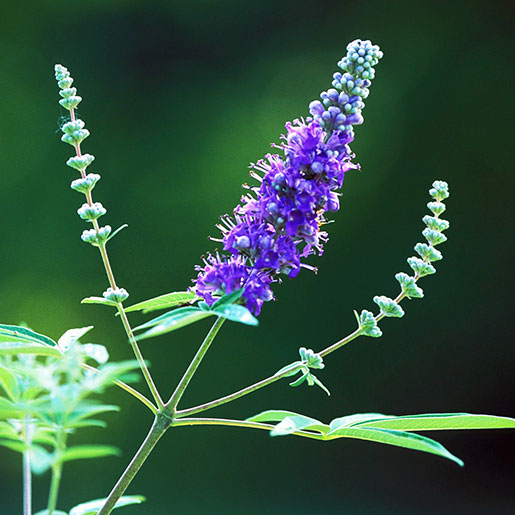
Common Names: chasteberry, chaste tree, vitex, monk's pepper
Latin Names: Vitex agnus-castus
Background
- The chasteberry plant, also called chaste tree, is native to the Mediterranean region and Asia.
- The name “chasteberry” may reflect the traditional belief that the plant promoted chastity. Monks in the Middle Ages reportedly used it to decrease sexual desire. In the past, chasteberry extracts were used to treat a variety of gynecological disorders and skin conditions.
- Today, chasteberry is promoted as a dietary supplement for symptoms of premenstrual syndrome, breast pain associated with the menstrual cycle, infertility, and other conditions.
How Much Do We Know?
- There’s not a lot of strong research on the effectiveness of chasteberry for any condition. We do have some clear safety information on the herb.
What Have We Learned?
- Preliminary studies suggest that chasteberry might be helpful for symptoms of premenstrual syndrome and for breast pain related to the menstrual cycle, but the evidence is not conclusive.
- Researchers have studied chasteberry for infertility in women, but there isn’t enough reliable evidence to know if it helps.
What Do We Know About Safety?
- When used in limited amounts, chasteberry appears to be generally well tolerated. Side effects are generally mild, and may include nausea, headache, gastrointestinal disturbances, or itching.
- Taking chasteberry during pregnancy or while breastfeeding may not be safe.
- It may not be safe for women with hormone-sensitive conditions, such as breast, uterine, or ovarian cancer, to take this herb. It’s possible that chasteberry might interact with some medicines, such as birth control pills, drugs used to treat Parkinson’s disease, and drugs used to treat psychosis. If you’re taking medicine, talk with your health care provider before using chasteberry.
Keep in Mind
- Take charge of your health—talk with your health care providers about any complementary health approaches you use. Together, you can make shared, well-informed decisions.
NCCIH Clearinghouse
The NCCIH Clearinghouse provides information on NCCIH and complementary and integrative health approaches, including publications and searches of Federal databases of scientific and medical literature. The Clearinghouse does not provide medical advice, treatment recommendations, or referrals to practitioners.
Toll-free in the U.S.: 1-888-644-6226
Telecommunications relay service (TRS): 7-1-1
Website: https://www.nccih.nih.gov
Email: info@nccih.nih.gov (link sends email)
PubMed®
A service of the National Library of Medicine, PubMed® contains publication information and (in most cases) brief summaries of articles from scientific and medical journals. For guidance from NCCIH on using PubMed, see How To Find Information About Complementary Health Approaches on PubMed.
Website: https://pubmed.ncbi.nlm.nih.gov/
Office of Dietary Supplements (ODS), National Institutes of Health (NIH)
ODS seeks to strengthen knowledge and understanding of dietary supplements by evaluating scientific information, supporting research, sharing research results, and educating the public. Its resources include publications (such as Dietary Supplements: What You Need To Know) and fact sheets on a variety of specific supplement ingredients and products (such as vitamin D and multivitamin/mineral supplements).
Website: https://ods.od.nih.gov
Email: ods@nih.gov (link sends email)
Key References
- Daniele C, Thompson Coon J, Pittler MH, et al. Vitex agnus castus: a systematic review of adverse events. Drug Safety. 2005;28(4):319-332.
- Mahady GB, Michel JL, Soni KK. Chaste tree. In: Coates PM, Betz JM, Blackman MR, et al., eds. Encyclopedia of Dietary Supplements. 2nd ed. New York, NY: Informa Healthcare; 2010:129-135.
- Ooi SL, Watts S, McClean R, et al. Vitex agnus-castus for the treatment of cyclic mastalgia: a systematic review and meta-analysis. Journal of Women’s Health. 2020;29(2):262-278.
- Verkaik S, Kamperman AM, van Westrhenen R, et al. The treatment of premenstrual syndrome with preparations of Vitex agnus castus: a systematic review and meta-analysis. American Journal of Obstetrics and Gynecology. 2017;217(2):150-166.
- Vitex agnus-castus. Natural Medicines website. Accessed at naturalmedicines.therapeuticresearch.com on October 16, 2019. [Database subscription].
This publication is not copyrighted and is in the public domain. Duplication is encouraged.
NCCIH has provided this material for your information. It is not intended to substitute for the medical expertise and advice of your health care provider(s). We encourage you to discuss any decisions about treatment or care with your health care provider. The mention of any product, service, or therapy is not an endorsement by NCCIH.